
Persistent phenotypic reference spaces for crop ranking
Researchers: Dr Kanthu Joseph Mhango
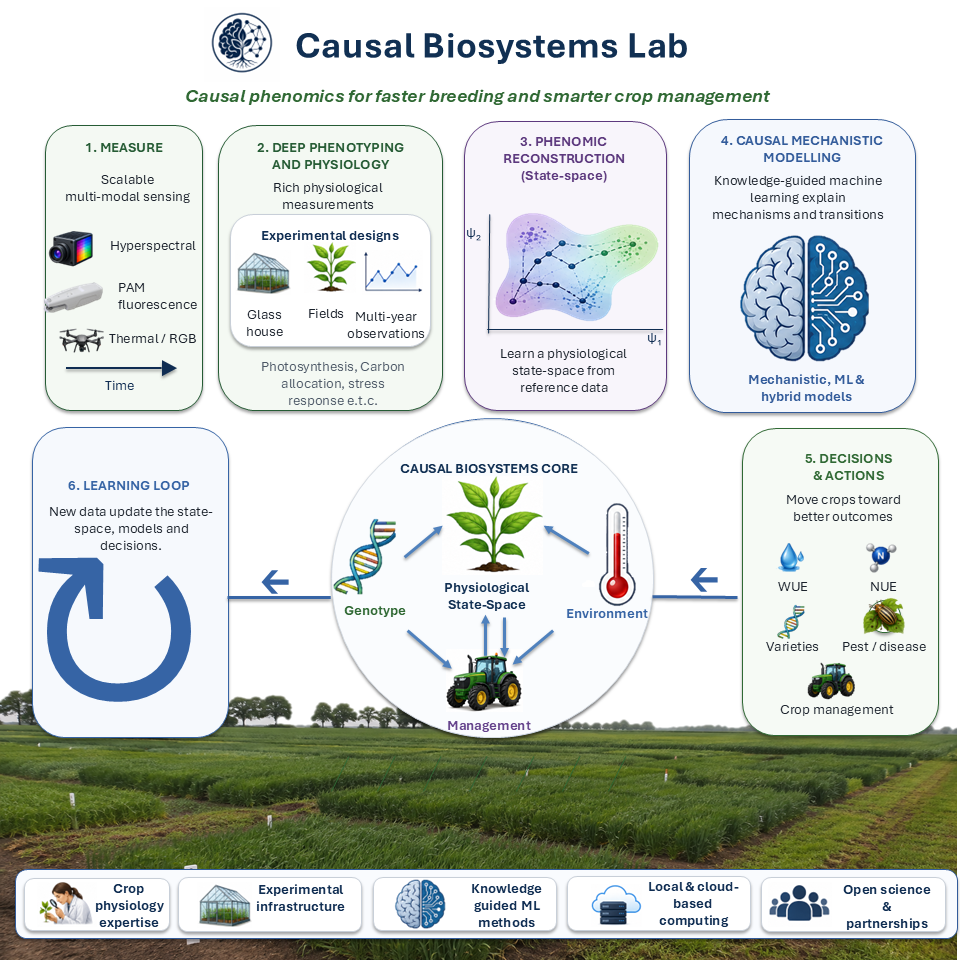
Most high-throughput phenotyping pipelines are rebuilt around one target and one experiment. Persistent phenotypic reference spaces ask a different question: can a crop programme establish a stable, target-independent geometry of realised plant function and reuse it when new genotypes, environments, sensors and breeding objectives arrive?
Scientific challenge
Phenotypes are longitudinal outcomes of genotype, developmental state, environment and management. Their coordinate system can rotate or change whenever preprocessing and dimensionality reduction are refitted, making apparent similarities difficult to interpret across trials. A reusable reference therefore requires a strict contract that defines the phenotype representation, freezes the projection pipeline and places new observations without using the new target data to reconstruct the map.
Research architecture
The programme builds coordinate phenomes from repeated measurements of development, canopy structure, resource capture and physiology. Longitudinal trajectories are aligned to biologically meaningful time, summarised without erasing dynamics and projected into a lower-dimensional reference space fitted only on designated reference material.
Validation operates at several resolutions, targeting specific fundamental questions in the advancement of phenomics and the search for a persistent universal plant phenome. We ask whether broad functional regions persist, whether local neighbourhoods are reproducible, whether unseen genotypes can be located without refitting, and whether multiple withheld traits can be overlaid on one unchanged geometry among other fundamentally substantive questions.
Uncertainty and resolution are central because a useful reference space may recover a broad region while failing to preserve an exact address. Reporting that distinction prevents a visually attractive embedding from being mistaken for a validated selection object.
Intended contribution
The long-term ambition is a versioned biological reference layer for crop improvement that is inspectable, reusable across targets and capable of supporting early selection while revealing how much information is lost through compression.