
Trainable mechanistic potato growth modelling
Researchers: Dr Kanthu Joseph Mhango; Megan J. Lewis; Joe M. Roberts; W. Edwin Harris
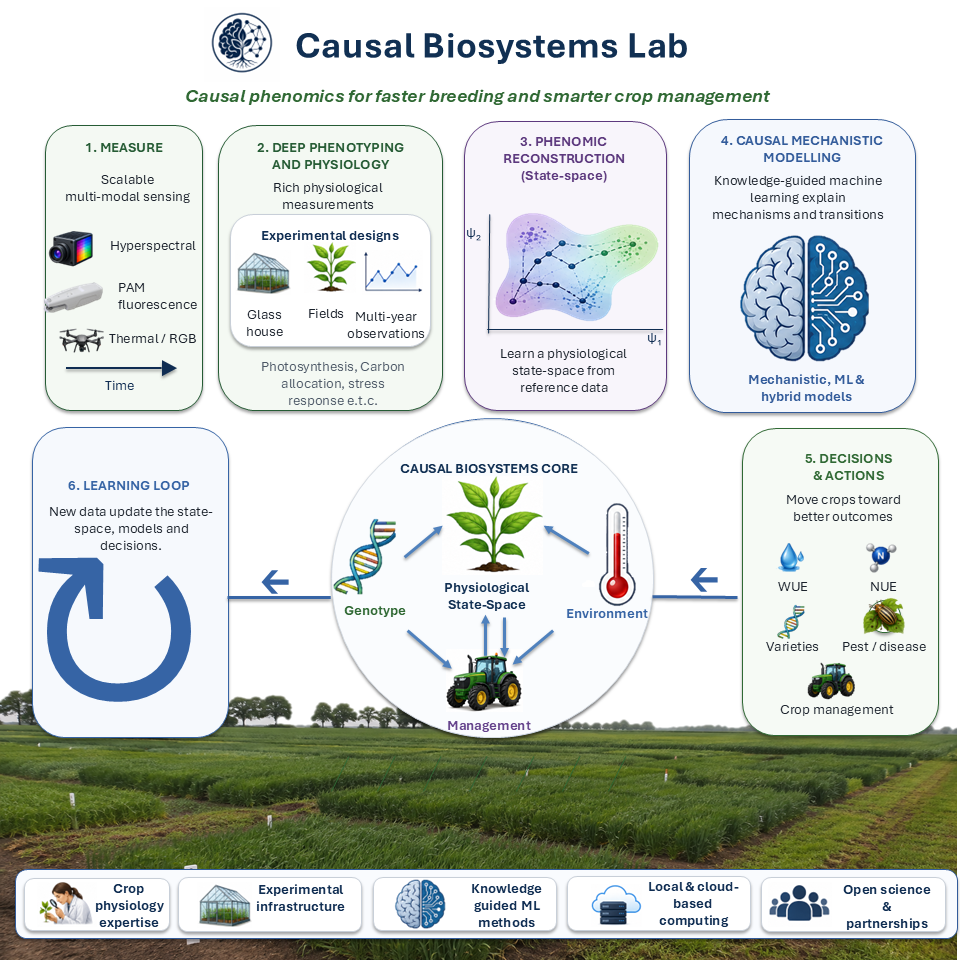
This programme explores a middle ground between fixed process-based crop models and unrestricted machine learning. The objective is to make physiological models trainable on local observations without surrendering the named mechanisms that make crop models scientifically useful.
Scientific challenge
Conventional models encode crop-growth theory but often depend on externally calibrated coefficients that are difficult to update for new populations. Black-box models adapt readily to weather, remote sensing and management data, yet they can achieve accurate predictions through representations with no stable physiological meaning. Neither extreme fully serves breeders who need to understand which route produced a yield outcome and where remaining improvement may lie.
Research architecture
The work represents crop growth as an explicit computational graph. Canopy development informs effective light capture; intercepted radiation passes through a conversion process to biomass; partitioning allocates biomass to the harvested organ. Trainable neural components infer selected mechanism values from longitudinal observations and environmental context, but they cannot bypass the physiological pathway through a free prediction head.
Inputs can include irregular crop sequences, radiation context, environment descriptors and sensor-derived canopy evidence. Physiological ranges and structural constraints are encoded directly into the model. Training is followed by a scientific audit where intermediate states are compared with independent physiological proxies where available; covariance is checked against the imposed graph; and counterfactuals ask whether changes propagate through the model in biologically admissible ways.
The wider software programme generalises this logic through the in-house Causality platform, where human-readable causal specifications compile into trainable models with inspectable nodes, constraints and dataset bindings.
Intended contribution
The ambition is a transferable method for programme-specific physiological inference—one that can learn from modest, heterogeneous datasets while retaining enough structure to support mechanistic comparison, experimental challenge and route-specific decision support.