
Breaking breeding bottlenecks
Researchers: Sarah-Jane Childs; Dr Kanthu Joseph Mhango; Dr Edwin Harris; Prof Jim Monaghan; Dr Edwin van der Vossen
This research project asks how breeding programmes can measure the physiological basis of field performance with high throughput. Potato is the model system, but the central problem is general generic phenotyping bottleneck in breeding. Breeders need early, repeatable evidence about crop function to pair with increasingly accessible genotyping and unlock accelerated selection.
Scientific challenge
Yield potential emerges from interacting processes including canopy establishment, light interception, photosynthetic capacity, dry-matter conversion and partitioning. Different routes can produce similar final outcomes, while genotype-by-environment effects continually change the observed canopy. Destructive measurements can resolve parts of this system but cannot be applied repeatedly across large breeding populations. Spectral and structural observations offer scale, yet they only become useful when linked to defensible crop physiology.
Research architecture
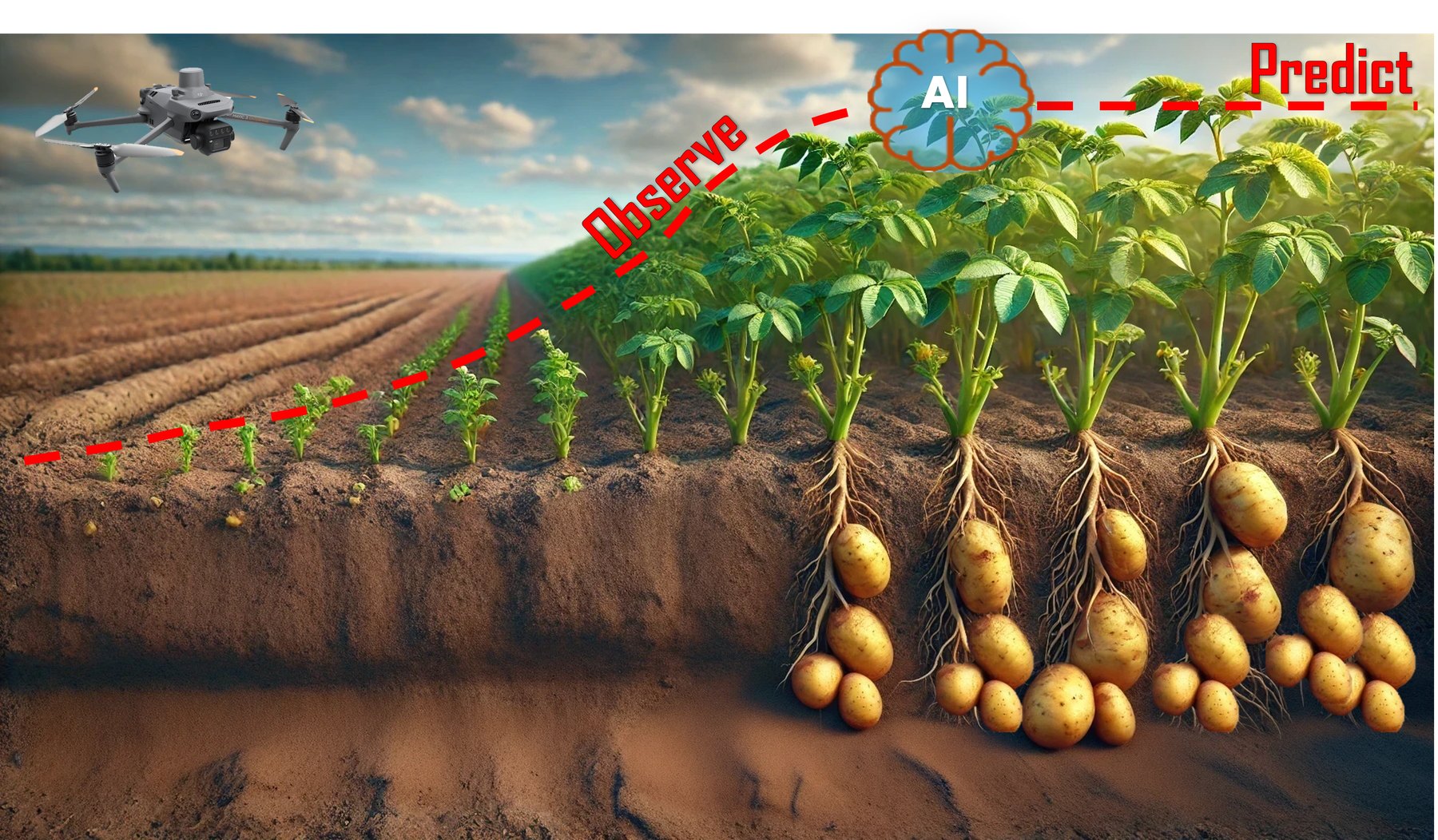
The project integrates repeated UAV sensing with field agronomy, physiological calibration and crop-growth modelling. Multispectral observations and derived canopy structure are treated as longitudinal evidence about crop state rather than isolated image features. Physics-based radiative-transfer models provide a route from reflectance to interpretable canopy properties, while experimental measurements anchor the biological meaning and limitations of those inversions.
These observation streams are assembled through a photogrammetry and feature engineering pipeline that preserves plot identity, acquisition context, phenological time and uncertainty. Machine learning is then used within a knowledge-guided framework, such that flexible components learn population- and environment-specific relationships, while the surrounding crop-growth structure keeps light capture, radiation conversion and yield formation explicit. The programme also examines data assimilation, quality control and missing-observation handling because operational high-throughput phenotyping depends as much on robust data engineering as on the final model.
Intended contribution
The ambition is an auditable phenotyping engine that can compare large field populations, identify contrasting physiological routes and provide earlier evidence about improvement potential. While such a system cannot replace breeder judgement or direct physiology; it is designed to direct scarce measurements and selection attention towards the most informative material.